
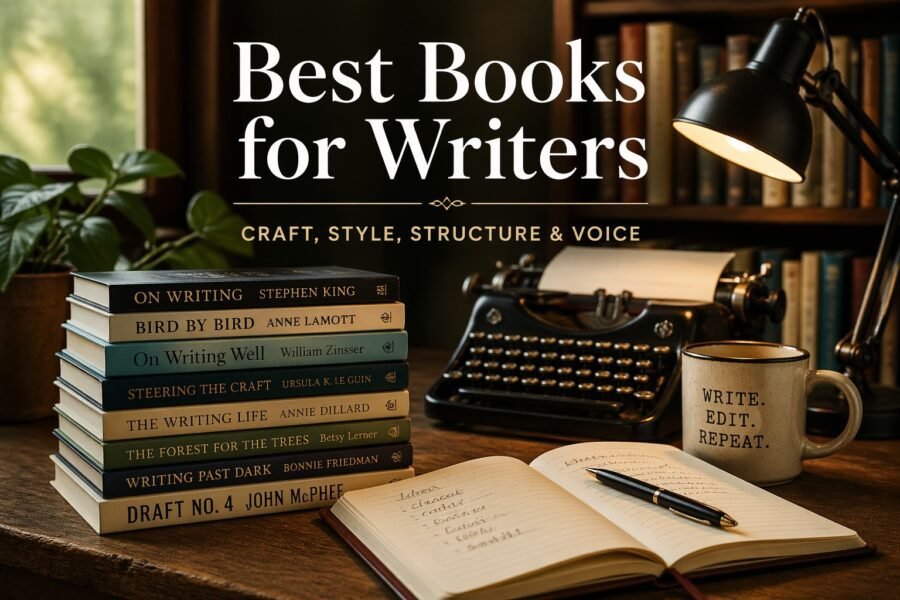
The best books for writers do not all solve the same problem. Some sharpen sentences. Some teach structure. Some help a writer survive doubt, vanity, and the long middle of a difficult project. Some restore ambition when language has gone flat. A serious writer needs all of these. A serious writer does not need one magic manual. A serious writer needs a shelf that keeps correcting weak instincts and expanding what the page can do.
This guide is built for that purpose. It gathers the books that most consistently matter to writers across fiction, poetry, essays, and literary nonfiction, then arranges them by function rather than by hype. The aim is simple: to help a writer choose the next useful book, not just admire a famous title from a distance.
Table of Contents
- What the Best Books for Writers Actually Teach
- The Core Shelf: Eight Books Almost Every Writer Can Learn From
- Books for Writers Who Need Stronger Sentences
- Books for Writers Who Need Structure
- Books for Writers Who Need Publishing and Industry Clarity
- Books for Writers Who Need a Real Voice
- Writers Should Read Books That Explain Why Literature Matters
- The Best Books for Writers Are Not Only Manuals
- A Practical Reading Path for Writers
- FAQ
What the Best Books for Writers Actually Teach
The strongest books for writers usually teach one or more of five things: sentence control, structural judgment, emotional honesty, artistic endurance, and literary range. Some books offer direct instruction. Others work more like pressure chambers, forcing a writer to confront what is missing in the work. That second category matters as much as the first. A writing life built only on tips stays shallow. A writing life built on real reading grows teeth.
Writers also improve faster when they read across forms. Fiction teaches motion, escalation, scene pressure, and narrative architecture. Poetry teaches compression, rhythm, image, and the handling of silence. Criticism teaches naming, and naming later becomes control. That is why any serious reading plan should move between prose, criticism, and poetry books instead of sealing itself inside one shelf.
The Core Shelf: Eight Books Almost Every Writer Can Learn From
On Writing by Stephen King
One of the clearest gateway books for writers because it joins memoir with practical craft. King is especially strong on work ethic, revision, clarity, and the relationship between talent and discipline. This is not the last book a writer needs, but it is often a strong first one because it turns writing into something concrete and daily rather than mystical.
Bird by Bird by Anne Lamott
Valuable for writers who need help with shame, paralysis, perfectionism, and messy first drafts. Lamott understands that the emotional life of a writer can ruin the work long before any technical weakness does. This book belongs on the shelf because it treats the writing life as a human reality rather than a performance of competence.
On Writing Well by William Zinsser
Essential for prose clarity. It is usually shelved as a nonfiction guide, yet fiction writers also benefit from it because the book is so sharp on clutter, rhythm, emphasis, and the relationship between thought and sentence shape. Writers who need cleaner pages often improve faster from this book than from many creative-writing manuals.
Steering the Craft by Ursula K. Le Guin
One of the strongest books on sentence movement, narrative control, and the feel of language in motion. Le Guin pays close attention to syntax, stress, repetition, pacing, and choice. Writers who want stronger instinct for musical prose and formal awareness should take this book seriously.
The Writing Life by Annie Dillard
This is not a manual in the narrow sense. It is a book about artistic seriousness, uncertainty, obsession, and the scale of the task. Writers who need reminders that art is difficult for honorable reasons often find this book more sustaining than any checklist-based guide.
The Forest for the Trees by Betsy Lerner
A sharp and unusually useful book about the psychology of writers, the publishing world, and the kinds of self-sabotage that repeatedly distort literary ambition. It helps writers see themselves more clearly, which is often the first step toward improving the work.
Writing Past Dark by Bonnie Friedman
Indispensable for writers whose biggest enemy is not lack of ideas but fear, envy, distraction, or inner sabotage. This book is quieter than some of the classics above, yet it speaks directly to one of the hardest truths of writing: many careers fail in the mind before they fail on the page.
Draft No. 4 by John McPhee
A major choice for writers who need stronger revision habits, better structural intelligence, and a more adult understanding of composition. McPhee teaches arrangement, compression, sequence, and the hard beauty of rebuilding a draft until it finally carries weight.
Books for Writers Who Need Stronger Sentences
Writers who want better prose often search for style when what they really need is sharper attention. Style is not ornament poured over weak thought. Style grows from pressure, selection, rhythm, and proportion. That is why books on language matter most when they train perception rather than merely offering rules. One useful companion to that training is a clear working grasp of poetic devices, because metaphor, contrast, sonic echo, repetition, and symbolic pattern all sharpen prose once a writer begins noticing them deliberately.
The same principle applies to form. Writers often claim they want freedom when in fact they need structure strong enough to reveal what their instincts are doing badly. That is one reason poets, novelists, and essayists all benefit from studying types of poems. Form teaches economy. It also teaches where energy comes from when a piece starts to move under its own weight.
Books for Writers Who Need Structure
Some books for writers matter less because of advice and more because they teach architecture. A writer may already produce fine paragraphs and still fail at large design. Chapters arrive in the wrong order. Information lands too early or too late. The narrator sits in the wrong distance from the material. Tone and sequence fight each other. This is why books like Draft No. 4 and Steering the Craft remain so useful, and why writers should also train themselves to think in structural terms through ideas like metanarrative. Once a writer can name the frame, the frame stops controlling the book from the shadows.
Writers who work in verse or lyrical prose need one more kind of structural intelligence: the ability to distinguish controlled looseness from slackness. A practical way into that distinction is to study free verse versus blank verse, because the contrast reveals how much formal pressure can remain present even when a piece appears relaxed on the surface.
Books for Writers Who Need Publishing and Industry Clarity
Some of the best books for writers become necessary the moment a manuscript starts moving from private labor toward public life. At that stage, craft alone stops being enough. A writer also needs to understand revision as a professional process, the role of editors, the economics of publication, and the difference between writing a book and building a writing life that can survive beyond one draft.
The Artful Edit by Susan Bell is especially useful for writers who need a more mature understanding of revision. It helps clarify what editing actually changes, how structure and emphasis shift under pressure, and why a strong draft often still needs a second intelligence applied to it. The Business of Being a Writer by Jane Friedman matters for a different reason: it teaches writers how publishing works as a system, how careers are built, and how literary ambition interacts with practical reality. What Editors Do by Peter Ginna rounds out this shelf by explaining what editors actually contribute to a book and how writers can think more clearly about the path from manuscript to publication, a subject that naturally belongs beside strong literary essays on how writing and judgment develop over time.
This category of reading protects writers from two opposite mistakes. One mistake is treating publishing as dirty contamination and refusing to learn anything about it. The other is treating publication as the only goal and flattening the work in pursuit of speed or approval. Books that explain the industry help a writer avoid both traps. They make it easier to revise with purpose, submit with intelligence, and understand how literary work moves through the world after it leaves the desk.
Books for Writers Who Need a Real Voice
Writers love the phrase find your voice, but voice usually appears later than expected. It tends to emerge after imitation, failure, embarrassment, correction, and years of reading writers whose sentences expose your own evasions. The books most useful here are the ones that make a writer ask harder questions: what kind of pressure does my language avoid, what kinds of truth do I soften, and what on the page actually sounds like me? A strong companion for that stage is a serious guide to how to develop and refine a unique poetic style and voice, because voice grows from repeated decisions, not from mood.
Writers who neglect this stage often become clever but interchangeable. Writers who work through it gain identity at the level of syntax, emphasis, and emotional risk. That is when the page starts carrying a signature rather than a borrowed manner.
Writers Should Read Books That Explain Why Literature Matters
A writing life can become trivial very quickly if it forgets what literature is for. One danger is empty self-expression. Another is empty professionalism. Both produce dead pages for opposite reasons. Books that restore seriousness therefore belong on a writer’s shelf even if they do not look like manuals. It helps to return now and then to arguments about why poetry is important, because the best answers illuminate prose as well. They remind the writer that language is not just a tool for communication. It is also a form of exactness, pressure, memory, and inner discovery.
That reminder changes standards. Once a writer remembers what the art can hold, weak shortcuts become harder to tolerate. Sentimentality looks cheaper. Cleverness without consequence looks thinner. The work begins asking more of the person making it.
The Best Books for Writers Are Not Only Manuals
Some of the most useful books for writers are not how-to books at all. They are books whose structure, pressure, or artistic temperature forces a writer to become more alert. Serious criticism belongs here, which is why a strong reading plan should always leave room for literary argument and reflective prose. Reading criticism trains distinction. It helps a writer tell the difference between intensity and melodrama, between breadth and bloat, between originality and random surface novelty.
Modern fiction matters for the same reason. A writer does not need to imitate the present, but a living writer should understand how the present has altered consciousness, speed, shame, desire, and form. That is why any lasting reading shelf should include sustained attention to modern literature. The point is not fashion. The point is contact with living temperature.
A Practical Reading Path for Writers
A strong sequence begins with one craft book, then one language book, then one structural book, then one work of criticism or literary reflection. For many writers, a practical order would be: On Writing, then On Writing Well, then Steering the Craft, then Draft No. 4, with Bird by Bird or Writing Past Dark brought in whenever morale starts breaking down. Writers who lean toward lyric prose or verse can strengthen that path by studying how to write poetry at the point where sentence-level control begins to matter more than raw output.
The best books for writers do not simply make a person more informed. They make weak pages feel weaker, stronger pages feel more demanding, and the real work of literature feel more exacting than it did before. That is precisely why they matter. A book that raises standards has already begun to improve the writer reading it.
FAQ
What are the best books for writers to start with?
A strong starting shelf includes On Writing by Stephen King, Bird by Bird by Anne Lamott, On Writing Well by William Zinsser, and Steering the Craft by Ursula K. Le Guin. Together they cover discipline, emotional survival, prose clarity, and formal control.
Do fiction writers need poetry books?
Yes. Poetry trains compression, rhythm, image, and tonal precision. Fiction writers who read poetry usually gain stronger sentences and better control of emphasis and silence.
Which books help most with structure?
Draft No. 4 by John McPhee and Steering the Craft by Ursula K. Le Guin are especially valuable for writers who need better arrangement, pacing, and control of narrative architecture.
What should writers read about publishing and editing?
The Artful Edit by Susan Bell, The Business of Being a Writer by Jane Friedman, and What Editors Do by Peter Ginna offer a strong foundation for understanding revision, editorial work, and the publishing world as a practical system.
How do writers develop a real voice?
Voice develops through sustained reading, imitation, correction, and repeated choices at the level of syntax, emphasis, and emotional risk. It grows much more from pressure and revision than from mood or self-conscious originality.
Are how-to books enough for a serious writer?
No. Writers also need criticism, literary essays, poetry, and modern fiction. Manuals teach technique, but serious reading teaches judgment, taste, proportion, and standards.